
Scalable intelligence for coral restoration
Know which corals can take the heat before you plant them. Phyto Optics pairs a field-ready optical probe with trained AI models that turn a five-minute, non-destructive scan into a thermal-tolerance prediction your restoration team can act on.
Free to reserve. No payment taken.
Bleaching is undoing decades of restoration work.
Restoration teams outplant thousands of corals a year, but without knowing which of them will survive the next marine heat wave. The best predictor — a coral's heat tolerance — has been expensive and slow to measure.
- 1Selection is mostly blind.Colonies are chosen for growth or convenience, not for whether they'll survive heat stress.
- 2Heat-stress testing doesn't scale.Experimental bleaching trials need specialised labs, equipment and weeks of work per batch.
- 3Most teams can't access it.Community-led programs and NGOs — especially in developing nations — rarely have those resources.
One system, from the reef to the decision.
Hardware alone just produces data. Phyto Optics is the full pipeline: measure in the field, process in the cloud, predict with trained models, and decide with analytics built for restoration.
MAPP instrument
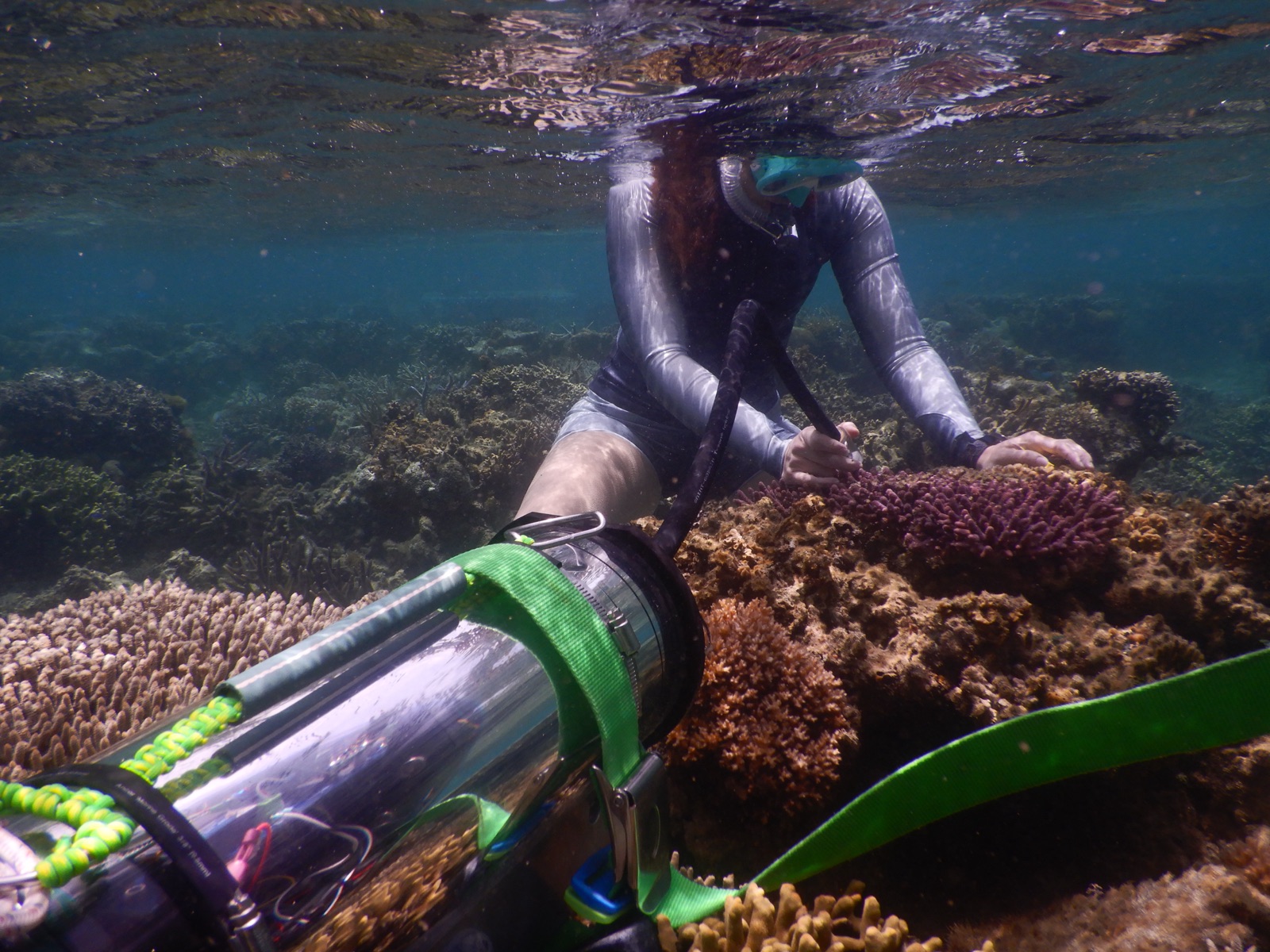
A submersible, 4-wavelength fluorometer that reads the algae living inside coral tissue — in the water, without taking a sample.
The instrument →Cloud Data Hub
Upload raw scans and get back standardised, analysis-ready data — alongside curated reference datasets from partner reefs.
Data Hub →Predictive models
Neural-network models trained on real bleaching outcomes and validated on reef sites they've never seen.
How models work →Analytics Studio
Rank colonies by predicted tolerance, cluster them by physiology, and compare nurseries, sites or genotypes.
Analytics Studio →From a coral's glow to a restoration decision.
Scan
Hold the MAPP probe to a colony. A standardised light-response program reads its photosynthetic health without harming it.
Upload
Send the raw files to the cloud Data Hub, where they're processed into thousands of physiological metrics.
Predict
Trained models estimate how each colony would respond to thermal stress — before any heat wave arrives.
Decide
Prioritise the most resilient corals for propagation and outplanting, and track how colonies change over time.
Built for the people restoring reefs.
Decide which corals to grow and plant.
Get a ranked, defensible answer to the question every nursery faces: which colonies are worth prioritising?
- Thermal-tolerance predictions for every scanned colony
- Models built by larger facilities can be shared with community-led programs in the same region
- Software and training videos included; no lab required
Information-rich physiology, collected in situ.
Non-destructive, repeatable measurements that let you follow the same colony through time, across sites and seasons.
- ~4,200 named photobiological metrics per measurement, fully documented
- Clustering, ordination and group-comparison tools in the browser
- Methods published in peer-reviewed journals
Built to scale beyond a single lab.
Experimental bleaching trials cost time, tanks and coral tissue for every batch. A MAPP scan costs a few minutes in the water, and every new scan adds to a shared model instead of starting over.
- Field-deployable in a submersible housing; no samples removed
- Cloud processing, so there's no local compute or specialist software to maintain
- Shared regional models lower the cost of each prediction as the network grows
Ready to bring trait-based selection to your program?
Reserving is free and holds your place in line. The more teams reserve, the lower the final price.
Free to reserve. No payment taken. Limited first production run.
Already using MAPP?
Upload scans, retrieve processed data and run analyses in the Data Hub & Analytics Studio. The app can take up to a minute to wake if nobody has used it recently.